

Make Self-Regulation Possible Even When Emotions Take Over
A realistic approach to self-regulation for parents in intense everyday moments


You know the importance of naming your emotions and building self-awareness, because that is how you begin to regulate yourself. But in the middle of a hard parenting moment, it is not always easy to understand how that helps.
When your child is melting down, resisting, whining, screaming, or pushing against every transition, you are not standing there calmly thinking about emotional regulation for parents. You are trying to make it through the moment. And many times, instead of offering the kind of guidance you wanted to give, you end up snapping.
Then, at the end of the day, it can feel like a never-ending loop of resentment, guilt, and disconnection. What stays with you is not only the hard moment itself, but the feeling that you lost the connection you wanted with your child. What you really wanted was the minimal steadiness to stay present when emotions went high.
Today, we are continuing our series on intentional self-regulation, now exploring the influence of our thoughts, beliefs, emotions, body sensations, and goals in that equation.
Parent self-regulation shapes parenting behavior in real disciplinary and stressful moments, and children also build self-regulation through supportive co-regulation over time.
Premium Subscribers will have access to self-reflection sheets to help them practice intentional self-regulation, so they won’t feel lost during hard moments.
The Gap Between Theory and Parents’ Reality
When I work with parents I always make sure to make clear that
Most advice on self-awareness and self-regulation is built around the idea that people can slow down and work on themselves. ANd That does matter. Stabilizing the nervous system helps us strengthen emotional regulation, increase awareness, and grow in our ability to respond with intention over time.
But for parents, that process often has to happen while life is still moving. And they need to know that their situation is special and inique in many ways.
We have endless responsibilities inside and outside the house. Bills to pay, deadlines to meet, housekeeping, meals, errands, emotional demands, and children needing us from all directions. So when a hard moment begins, there is rarely a perfect setup for calm reflection.
That is why so many parents search things like how to stop yelling at your kids, snapping at my child, toddler tantrums, parenting triggers, mom rage, or why do I feel so overwhelmed as a mom. These are not dramatic phrases. They reflect the real experience of trying to stay steady while leading a family. Online, parents often describe feeling “so overwhelming and impossible,” feeling like they are “always mad,” or asking how to stop feeling like an “angry mom 24/7.”
You may know that breathing helps. You may know that naming emotions helps. You may know that calm parenting and co-regulation matter. But when you are the one in charge and your toddler is screaming, your baby is crying, and the clock is moving, there is no magical pause button.
The pressure is real. And the time does not stop for us.
An Approach Tailored for Parents
Research shows that capacity varies from one parent to another. That means the level of challenge, the level of support needed, and the pace of stabilization will vary from one person to another, too. Some parents are already beginning the day depleted. Some are carrying stress, burnout, sensory overload, or old experiences that get activated in parenting. Some can identify emotions quickly but still struggle to shift direction in the moment.
So this information is for every parent, but the pace of awareness will not look the same for everyone.
That is why, instead of only naming feelings, we are going to connect them with actions (and the situation) and thoughts in the moment. Also, pay attention to body sensations and have our beliefs well established. And then our goals for the situation.
I know it can sound like a lot, but this approach is practical because it helps you work on self-regulation not as a single moment, but as a whole, robust system that can truly support you over time.
And that’s how I work with my 1:1 clients, supporting them even in the early stages. I like to start with small steps in each area so the improvements are easier to notice.
This is a Cognitive Behavior Therapy flow that illustrates this :
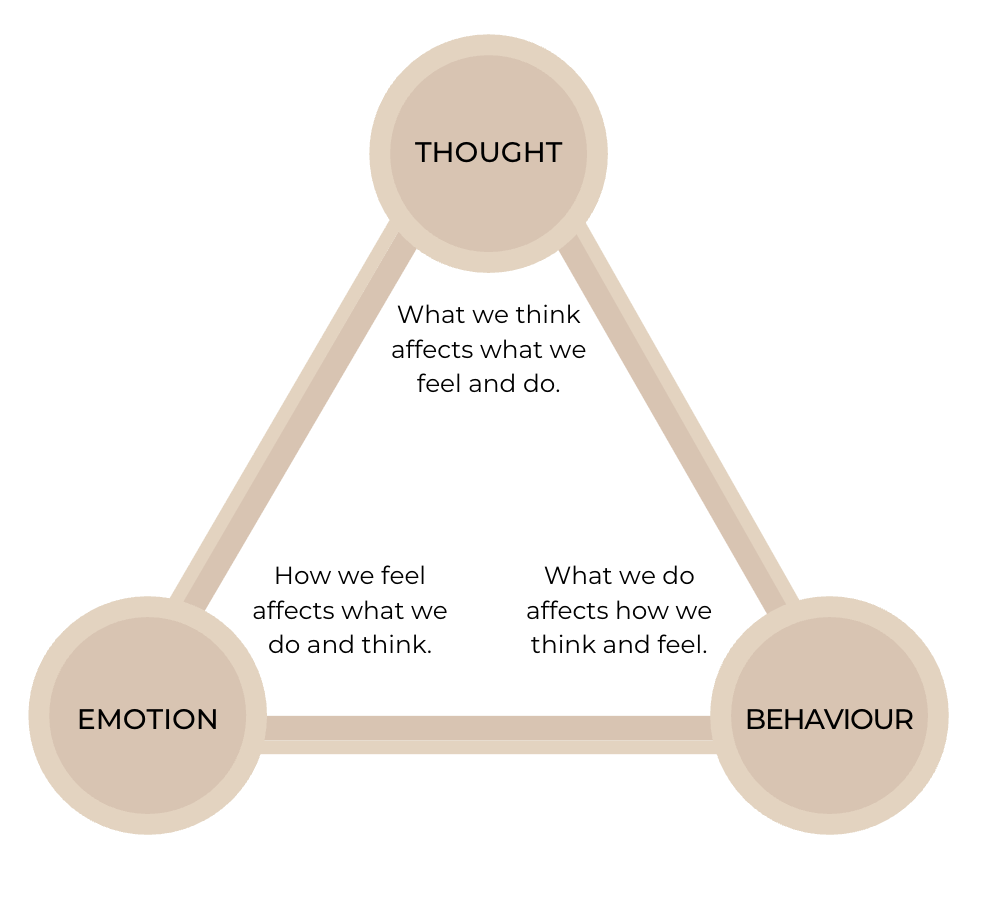
And around this process, two other things matter deeply:
Beliefs shape the meaning you give to the situation.
Goals shape the direction you want to move in your response.
This is where intentional self-regulation becomes more concrete.
Difference Between Beliefs and Thoughts
In a hard moment, the first thing you usually notice is the thought.
Your child is crying, resisting, or yelling, and your mind starts moving fast: We’re late. They’re not listening. I can’t do this right now.
Those are thoughts. They are quick, immediate, and tied to what is happening right then.
But underneath them, there is often something deeper. A belief.
A thought may say, This is too much.
A belief may whisper, If I can’t handle this well.
That is why parenting moments can feel so intense. It is not only the situation itself. It is also the meaning your mind is attaching to it.
When you begin to notice that, your reactions start making more sense.
As you can see, a thought is just a thought. It can come without invitation.
A belief, on the other hand, is part of the foundation of your mind and needs to be aligned with reality.
Naming Feelings and Body Sensations Intentionally
Many times, you know you feel off, but you do not stop long enough to understand what that means.
Maybe it is frustration. Maybe it is anxiety. Maybe it is helplessness, pressure, or shame. At the same time, your body is already reacting. Your chest feels tight, your jaw is tense, your shoulders are hard, and your breathing is short.
They are your body’s way of telling you that your nervous system is getting activated and that the moment is starting to run ahead of your awareness.
So, intentional naming can be very simple: I feel overwhelmed. My chest is tight. I’m rushing.
That kind of clarity helps you catch yourself sooner.
Situation and Goals
The situation is what is happening in front of you. Your child is crying, resisting, yelling, or moving slowly when life is asking you to move fast.
The goal is what you are moving toward in your response.
When you are overwhelmed, the goal can quickly become: make this stop, get control back, end the noise. And that makes sense when pressure is high.
But when you reconnect with a more intentional goal, the moment shifts. Now the goal becomes: stay steady enough to lead, help my child through this, hold the boundary without losing connection.
The situation may still be hard, but the goal gives direction to your response. And that is where self-regulation starts becoming practical.
Now, let’s picture 2 different scenarios: an internal chaotic situation and an internal stable situation
Here’s an internal chaotic situation
It is the end of the day, and you are already running on fumes. There is still so much to do, and your child refuses to put on shoes when it is time to leave. You ask, they resist, and the pressure inside you starts building fast.
But you do not stop long enough to notice what is happening.
You do not know exactly what you are feeling. You are not aware that your breathing has gotten shallow, that your chest is tight, or that your body is moving with tension. The emotions are rising, but they are rising faster than your awareness. So instead of slowing down, you keep rushing. You keep pushing. You keep trying to force the moment forward.
Your voice changes. Your actions get harder. The pressure in you starts pouring into the situation, and your child responds to that intensity too. What started as resistance now becomes a full storm, and you are both caught in it.
Underneath it all, thoughts are moving quickly, beliefs are being activated, emotions are climbing, and your only goal in that moment is to get through it somehow. But because you are not paying attention to what is happening inside you, your actions begin leading the moment more than your intention does.
That is often how disconnection happens in real time.
Now, let’s imagine this internal stable situation
It is still the end of the day. You are still tired, and your child is still refusing to put on shoes. The situation is still hard.
But this time, before pushing harder, you notice yourself. You realize your breathing is short, your body is tense, and your emotions are rising. As you pay attention, you recognize the frustration, pressure, and overwhelm building inside you.
Then you catch the thought: This is getting out of control.
Underneath it, you have worked on your belief beforehand: I can manage this well, because I know what to do.
And from there, you reconnect with your goal. Not just to stop the moment, but to guide your child through it with steadiness.
So your voice slows down. Your body softens. You get closer and say, “You’re having a hard time. We do need to leave, and I’m going to help you.”
The situation has not disappeared, but now your actions are guided by awareness rather than pressure.
When emotions and thoughts feel like they are attacking you, self-regulation can feel almost impossible. That is why so many parents search for things like how to stop yelling at my child, parent burnout, mom rage, emotional regulation for parents, calm parenting, and parenting triggers. They are trying to understand what is happening inside them while they are still trying to care for their child.
Often, your thoughts, beliefs, emotions, body sensations, and goals are moving at once. And the moment becomes too fast to understand from the inside.
As you begin to slow that process down and recognize each part more clearly, you create more room for steadiness. Not perfect steadiness. Just enough steadiness to stay present and return to the kind of parent you want to be.
In the next post this week, we will keep building on this by going deeper into the connection between emotions, beliefs, thoughts, and goals.
Until next time.
Take care,
Emilze - Mental Health for Parenting Author
References
Beck, J. S. (2021). Cognitive behavior therapy: Basics and beyond (3rd ed.). Guilford Press.
Lobo, F. M., Lunkenheimer, E., & Bell, M. A. (2021). Understanding the parent-child coregulation patterns shaping child self-regulation. Developmental Psychology, 57(7), 1121–1134.
Lunkenheimer, E., Sturge-Apple, M. L., & Kelm, M. R. (2023). The importance of parent self-regulation and parent-child coregulation in research on parental discipline. Child Development Perspectives, 17(1), 25–31. https://doi.org/10.1111/cdep.12470
Morris, A. S., Silk, J. S., Steinberg, L., Myers, S. S., & Robinson, L. R. (2007). The role of the family context in the development of emotion regulation. Social Development, 16(2), 361–388. https://doi.org/10.1111/j.1467-9507.2007.00389.x
Paley, B., & Hajal, N. J. (2022). Conceptualizing emotion regulation and coregulation as family-level phenomena. Clinical Child and Family Psychology Review, 25(1), 19–43. https://doi.org/10.1007/s10567-022-00378-4
Palmer, A. R., Oosterhoff, B., Bower, J. L., Kaplow, J. B., & Alfano, C. A. (2019). Parental emotion regulation strategies and parenting quality predict child internalizing symptoms in families experiencing homelessness. Social Development, 28(4), 891–900.
Planalp, E. M., Nowak, A. L., Tran, D., Lefever, J. B., & Kamp Dush, C. M. (2022). Positive parenting, parenting stress, and child self-regulation patterns differ across maternal demographic risk. Journal of Family Psychology, 36(5), 713–724. https://doi.org/10.1037/fam0000934
Stuhrmann, L. Y., Göbel, A., Bindt, C., & Mudra, S. (2022). Parental reflective functioning and its association with parenting behaviors in infancy and early childhood: A systematic review. Frontiers in Psychology, 13, Article 765312. https://doi.org/10.3389/fpsyg.2022.765312
Zahl-Olsen, R., Mayers, A., Barker, T. H., & Wollscheid, S. (2023). Effects of emotionally oriented parental interventions: A systematic review and meta-analysis. Frontiers in Psychology, 14, Article 1076985.